Improving Transaction Clarity in Mobile Banking
I led the design of a transaction enrichment experience in the ING mobile banking app to help customers better recognise their purchases. The feature introduced clearer merchant information and reduced fraud-related contact centre calls by over 30%.
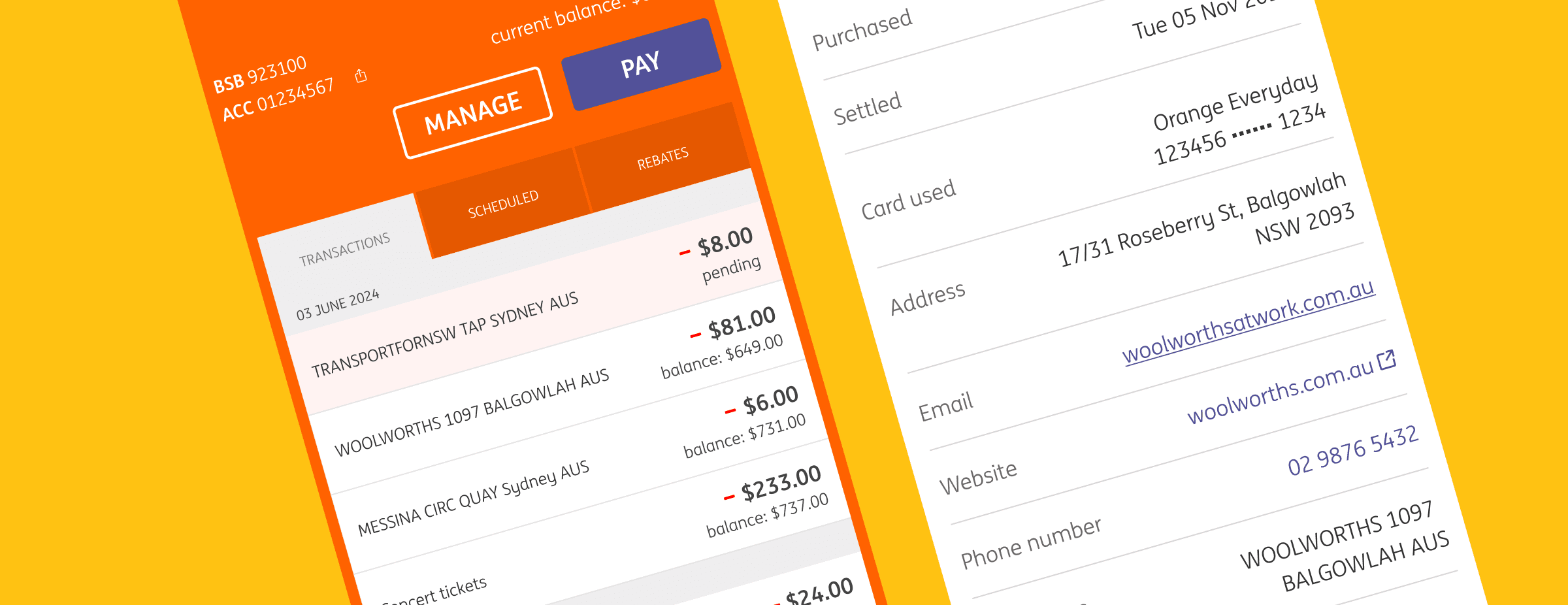
Overview
Customers often struggled to recognise transactions in the ING mobile banking app. Many payments displayed technical processor names rather than the actual merchant, leading customers to worry that their card had been compromised.
Customers had requested richer transaction details for years, and competitor banking apps were already providing richer merchant information.
As part of an initiative to improve the legacy app experience while a new platform was being built, I led the design of a transaction enrichment feature to improve merchant clarity.
The Problem
Transaction related support calls was in the top 10 call drivers. Transaction descriptions often looked like this:
PAYPAL *XYZ LTD
POS 384728394
SQ *MERCHANT123
These labels often reflected processors rather than recognisable merchants. For customers, that meant the app wasn’t helping them answer the most important question: “What was this payment actually for?”
When that answer isn’t clear, customers take the safest path: they contact the bank. That’s costly for the business and stressful for customers.
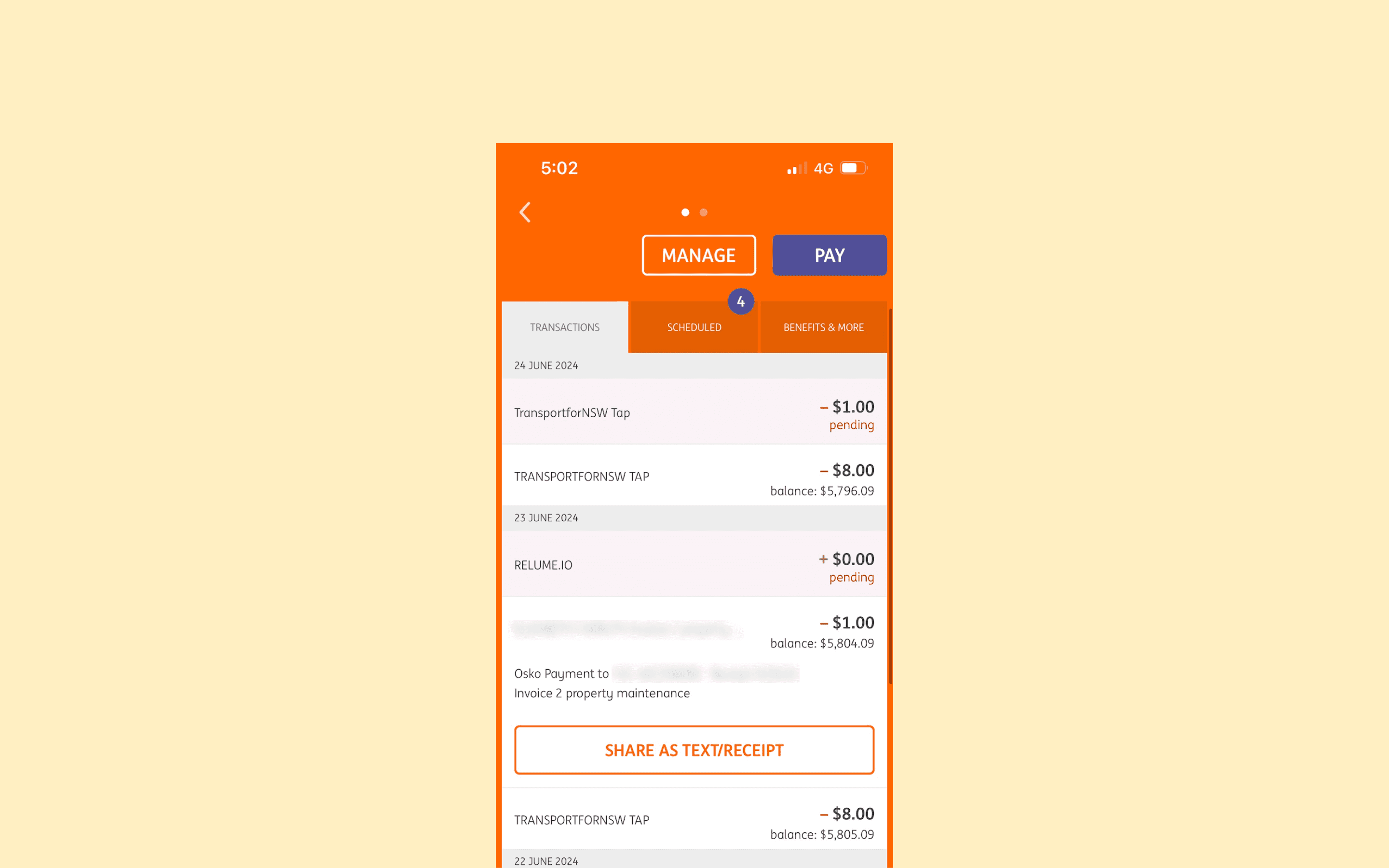
Above: A before snapshot of the transaction list screen. When tapping on a transaction, it would expand to reveal a very limited set of data on that purchase.
Opportunities
Stronger competitive positioning
Meet market expectations where enriched transaction details are increasingly standard
Improve transaction clarity
Make it easier to recognise purchases and reduce anxiety when reviewing spending
Reduce fraud-related support calls
Enable customers to self-verify purchases without needing to call the bank
Research and Discovery
Customer feedback
Years of customer feedback consistently pointed to the same friction: customers couldn’t recognise transactions from the description alone. This extended past being a quality of life issue, it became a trust issue. A lack of clarity meant uncertainty at a critical moment in the banking experience.
Competitor analysis
I reviewed competitor banking apps to understand:
What information they prioritised (merchant name, logo, category, context)
How they structured the hierarchy to support quick scanning
What patterns appeared consistent across leading apps
The goal wasn’t to copy competitors, but to align with what customers already consider “normal” in digital banking, so the experience would feel familiar and credible.
Collaborating with Merchant Data Providers
To enrich transaction details in our app, we partnered with a third party vendor to provide reliable transaction data for thousands of merchants across Australia.
Since the experience would only work if the data was reliable and easily understood by customers, I collaborated bi-weekly with the third-party vendor and our engineers to understand how enrichment would work and what constraints existed. In working sessions, I asked capability questions about:
How merchant data would be returned and structured
How transactions would be matched to merchants
The edge cases we’d need to handle (ambiguous matches, missing data, variations across transaction types)
Designing within constraints
Working with old architecture, a key limitation emerged: transactions couldn’t be enriched in real time. An API call was required to fetch merchant data for each transaction.
To remedy this as best as I could, I:
Simplified the layout to prioritise essential information
Avoided non-essential elements that could impact performance
Ensured the design still worked when enrichment data was partial or delayed
This made it so while enrichment wasn't in real time, it was still quick and easy for customers to glance at a transaction and feel secure that they made that payment.
Testing and Iterating
The goal of the enrichment was to help customers quickly answer a simple question:
I began by exploring several wireframe variations to determine how merchant information and supporting details could be presented clearly. I constantly sparred these designs with designers, engineers and the vendor for feedback.
I conducted usability testing with customers to evaluate whether the enriched transaction information improved clarity. Participants were asked to review transactions and explain what they believed each purchase represented.
The enriched designs significantly improved recognition compared to the previous experience. Testing feedback helped refine:
Information hierarchy
The amount of supporting information displayed
These insights were incorporated into the final design.
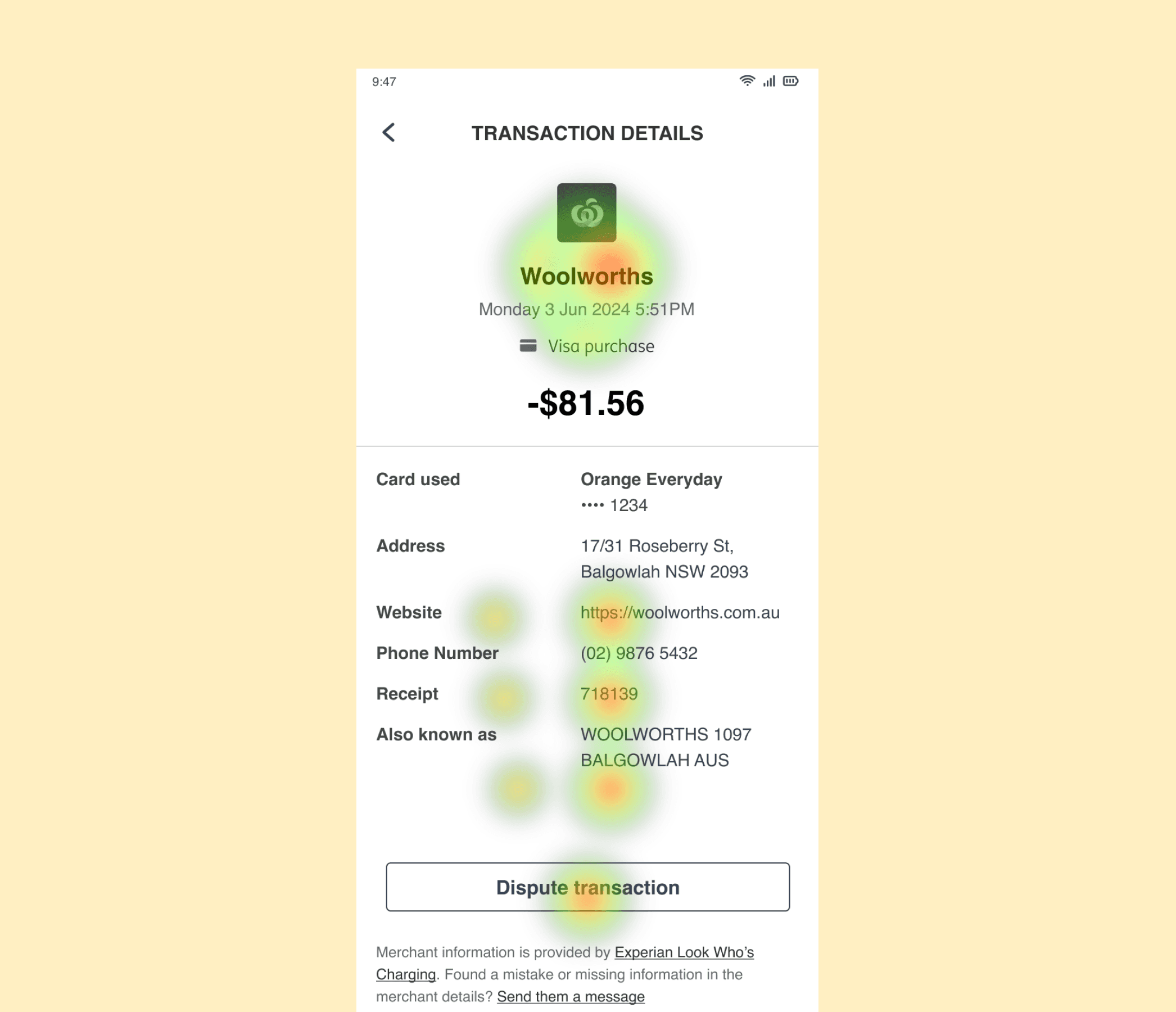
Above: Heatmap from quant testing sessions
Final Solution
The final experience introduced a dedicated enriched transaction screen that provided clearer merchant information and supporting context. Customers could now quickly see:
The actual merchant name
Clearer transaction details
Additional context when available
This made it much easier for customers to recognise their purchases and confirm whether a transaction was legitimate.
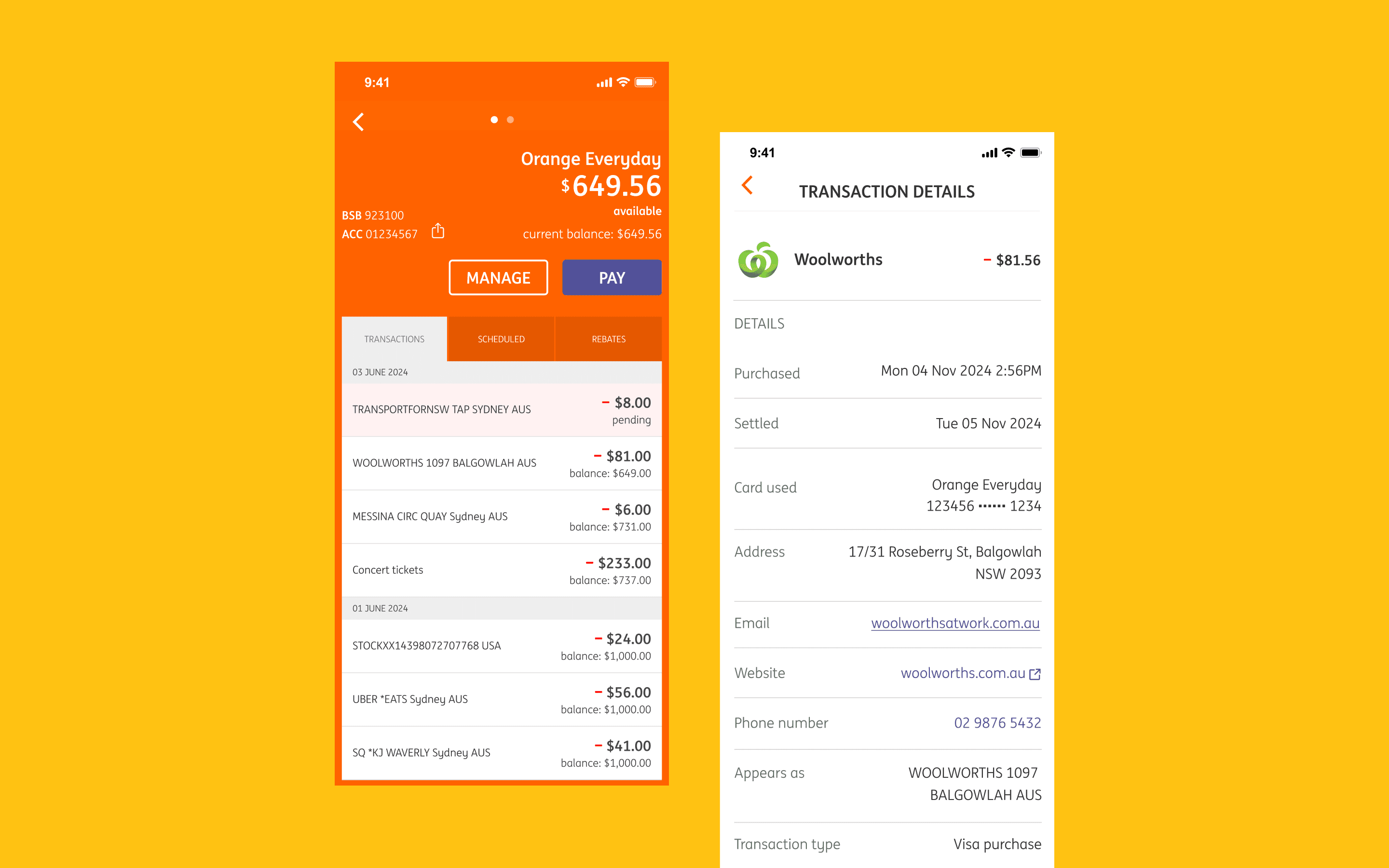
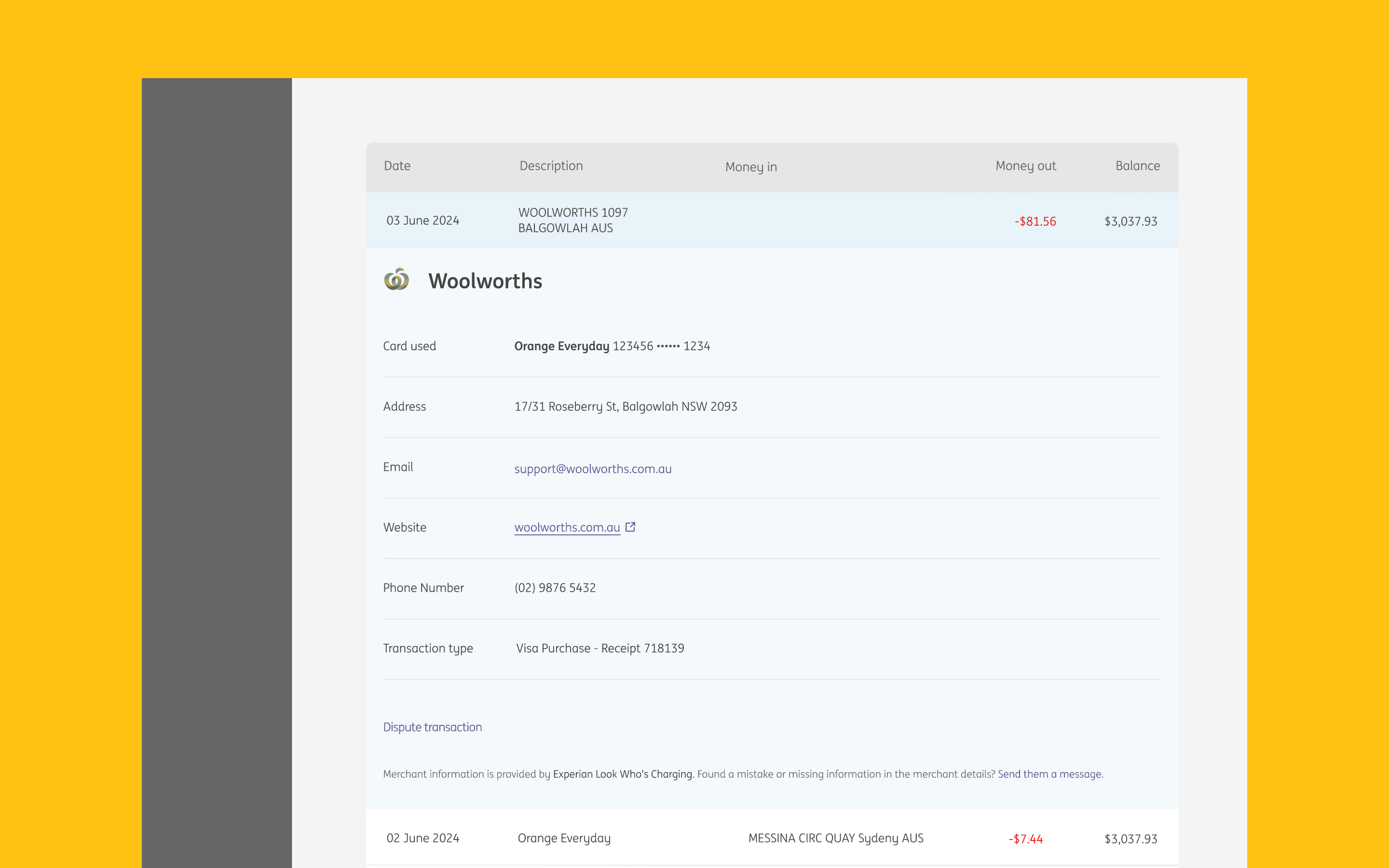
Above: The final UI with a completely new transaction details screen (mobile) and enriching the details in online banking too (desktop)
Impact
Reduced support calls
Fraud-related contact centre enquiries dropped by over 30%, as customers were better able to recognise their purchases.
Operational cost savings
The reduction in support enquiries saved the bank an estimated $480,000 in 2025.
Improved customer experience
Customers could more easily understand their transactions, reducing confusion and anxiety around potential fraud.
Scaling the Feature to the New Mobile Platform
Following the success of the feature in the legacy app, I later redesigned the experience for ING’s new mobile banking platform.
This introduced additional constraints, including alignment with global design standards used across multiple ING markets.
At the same time, I pushed for real-time enrichment as a core feature and must have, enabling quicker, more seamless merchant identification.
My thoughts on this project
This is a project I pushed hard to get off the ground. Customers had been requesting this for years, but we were in the midst of building a new app from scratch, all hands on deck. With the new app still a year out however, I was part of a small team who carved out some time for an initiative to improve the current app experience.
After working on the new app, with new architecture, going back to the older app brought plenty of challenges. Time, effort and technical constraints were limiting, however this project flexed my skills in being adaptive, and working past these blockers to deliver a great solution for customers.
Project Outline
ROLE
Lead Product Designer
Company
ING
Date
2025
Team
2 Product Owners, 4 Engineers